Why Does My Moisturizer Burn Suddenly? What Your Skin Is Trying to Tell You
Disclaimer: This article is intended for informational purposes only and does not constitute medical or dermatological advice. Always consult a licensed skincare professional before introducing new active ingredients. Some links in this article are affiliate links, meaning PDRN Science may earn a commission at no cost to you.

The Day Your Moisturizer Turned Against You
You reach for your moisturizer the same way you have every morning for the past six months. Same bottle. Same routine. Same two pumps into your palm.
Then you apply it and your face starts to burn.
Not the gentle tingle that some active products warn you about on the label. A real, unwelcome sting that makes you rinse it off faster than you applied it.
The instinct is to blame the product. Maybe it went bad. Maybe they quietly changed the formula. Maybe you picked up the wrong bottle by accident.
But here is the truth: most of the time, the product is not the problem. Your skin is. And the burning is not a random reaction. It is your skin barrier telling you, in the only language it has, that something has gone wrong beneath the surface.
This article breaks down exactly why your moisturizer suddenly burns, what is actually happening at the skin level, and what you need to do to get your barrier back to a place where your routine works with your skin again instead of against it.
What Is Actually Happening When Moisturizer Burns
To understand why moisturizer stings, you first need to understand what your skin barrier is and what it does.
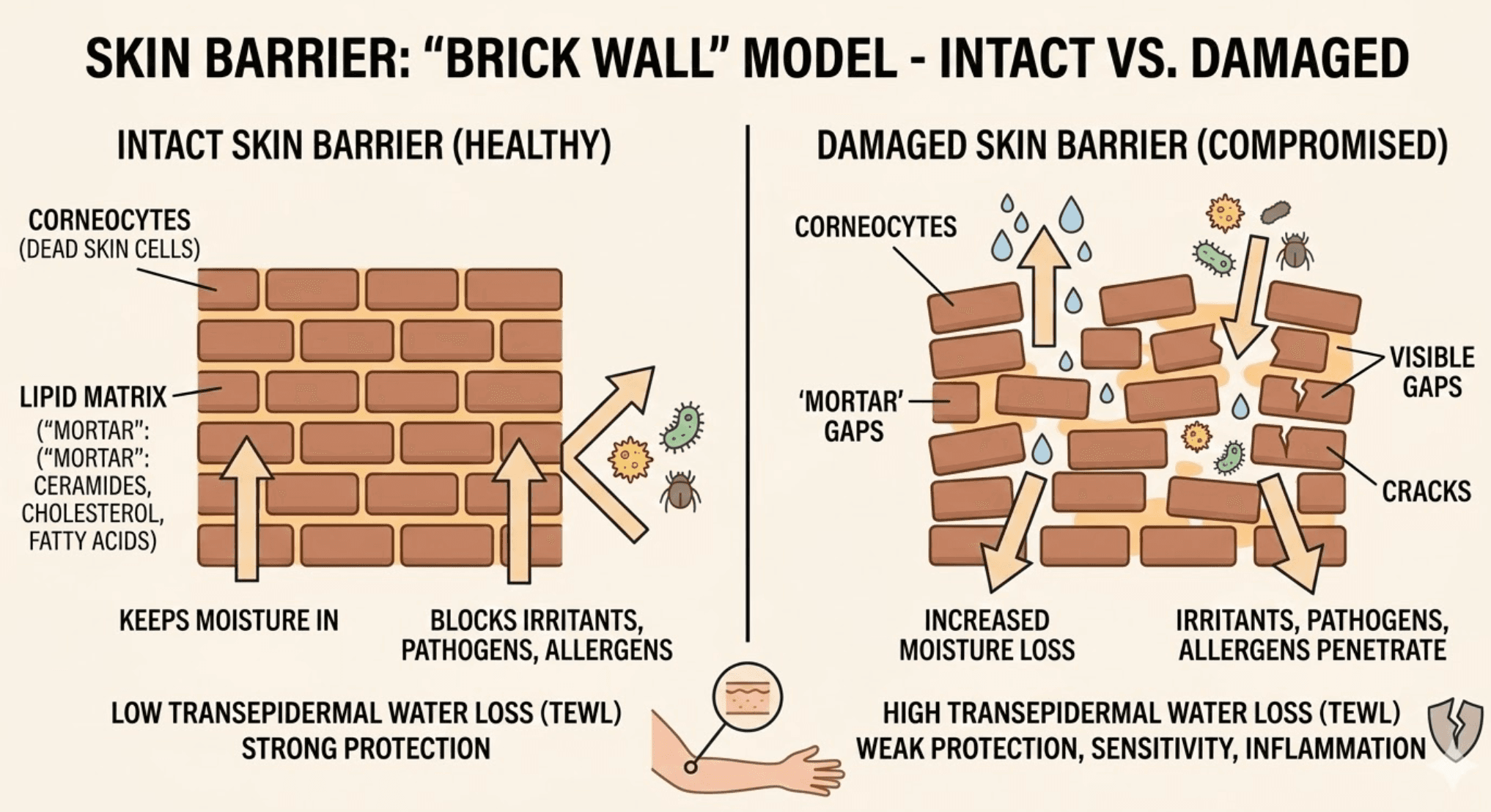
Your skin barrier, technically called the stratum corneum, is the outermost layer of your skin. Think of it as a brick wall. The skin cells are the bricks, and a mix of lipids, including ceramides, fatty acids, and cholesterol, acts as the mortar holding everything together.
When that wall is intact, it does two important jobs. It keeps moisture locked inside your skin and it keeps irritants, bacteria, and environmental aggressors out.
When the barrier is compromised, that wall develops gaps. Moisture escapes. Things that should stay outside get through. And when an ingredient from your moisturizer, even a gentle one, passes through those gaps and reaches the nerve endings underneath, you feel it as a burning or stinging sensation.
This phenomenon has a clinical name. Researchers call it sensitive skin reactivity, and it has been studied for decades as a reliable indicator of impaired barrier function. The classic "stinging test," used in cosmetic dermatology research, involves applying lactic acid to the nasolabial folds and measuring the reaction. People with damaged barriers sting consistently. People with intact barriers largely do not.
So when your moisturizer burns, it is not because the moisturizer suddenly became toxic. It is because your skin no longer has the defenses to handle it.
The Most Common Reasons Your Skin Barrier Gets Damaged
Understanding why the barrier breaks down helps you figure out what went wrong and how to stop it from happening again.
Over-Exfoliation
This is the most common cause of barrier damage in modern skincare routines, and it is responsible for more cases of sudden stinging than most people realize.
Chemical exfoliants like AHAs, BHAs, and retinoids are genuinely useful when used correctly. The problem is that skincare culture has drifted toward a "more is more" approach. People layer acid toners on top of exfoliating cleansers, use them daily, and interpret the tingling as proof that the product is working hard.
What that tingling often signals is that the barrier is being eroded faster than it can rebuild itself.
If you have been exfoliating more than two to three times per week, or if you have been combining multiple exfoliating actives without adequate recovery time in between, over-exfoliation is the most likely reason you are reading this article.
Stripping Cleansers
Harsh surfactants remove not just dirt and makeup but the natural lipids your skin needs to stay structurally intact. Foaming cleansers that leave your face feeling tight and squeaky clean after washing are often doing more harm than good.
If your skin feels uncomfortably dry within minutes of cleansing, your cleanser may be one of the primary contributors to your barrier struggle.
Environmental Stress
Cold weather, low humidity, wind, and dry indoor heating all draw moisture out of the skin continuously. Prolonged exposure without adequate protection weakens the barrier over time. Many people notice a sharp increase in sensitivity during winter months for exactly this reason. The seasonal pattern is a clue worth paying attention to.
Stress and Poor Sleep
The connection between stress and skin reactivity is physiological, not just anecdotal. Elevated cortisol disrupts the skin barrier repair cycle at a biochemical level. Poor sleep slows the cellular recovery process your skin relies on to rebuild during the night. If you have been sleeping poorly or under chronic stress, your skin is likely rebuilding at a slower rate than it is breaking down.
Incorrect Product Layering
Some ingredients compete with each other or shift the skin's pH in ways that accelerate barrier breakdown over time. Using vitamin C, retinol, AHAs, and BHAs in overlapping routines without understanding how they interact creates a chemical environment that even healthy skin struggles to manage. Compromised skin simply cannot handle it.
If you are not sure what is in your products or how those ingredients interact with one another, the PDRN Science Ingredient Decoder can help you audit your routine ingredient by ingredient before you go further.
Why the Burning Happens Even With Gentle Products
This is one of the most frustrating parts of dealing with barrier damage. You can switch to the most fragrance-free, hypoallergenic, dermatologist-recommended moisturizer on the market and it will still burn if your barrier is compromised enough.
The burning is not caused by harsh ingredients contacting a resilient skin surface. It is caused by any ingredient, including water, reaching exposed nerve endings through a barrier that no longer provides adequate protection.
Some ingredients are more likely to provoke the stinging sensation than others. Propylene glycol, a common humectant found in many moisturizers, is one of the most frequently cited. Alcohol can sting on broken skin even in small amounts. Certain preservatives and emulsifiers also provoke reactions in people with disrupted barriers.
But the key insight is this: the ingredient is rarely the root cause. The barrier state is the root cause. Repair the barrier, and most of these reactions stop on their own without any change to the products you are using.
How to Tell if Your Skin Barrier Is Damaged Beyond the Burning
Burning moisturizer is one signal. But there are others, and they often appear together in clusters.
- Tightness after cleansing. Skin that feels uncomfortably taut within minutes of washing is losing moisture faster than a healthy barrier would allow.
- Redness that was not there before. Not the flushing associated with rosacea, but a persistent low-grade redness that has become a new baseline.
- Breakouts that do not behave like normal acne. Barrier damage and acne frequently look similar but require completely different treatments. When the barrier breaks down, small inflammations can appear that resemble acne but do not respond to typical acne treatments. Treating barrier breakout with more actives makes it significantly worse.
- Skin that reacts to products it used to tolerate. This is the clearest indicator of all. If your roster of long-trusted products has suddenly become irritating, your skin changed. The products did not.
- Texture changes. Flakiness in areas that are not naturally dry, or a rough, uneven texture that appeared without explanation, often points to barrier disruption rather than dehydration alone.
If you are noticing several of these signs at the same time, the PDRN Science Barrier Scanning Tool can help you assess the current state of your barrier and give you a clearer picture of where to start.
The Skin Barrier Repair Process: What Actually Works
Once the barrier is damaged, the path back to healthy skin is not complicated. But it does require you to stop the practices that are making things worse and start giving your skin the raw materials it needs to rebuild.
Step One: Eliminate the Aggravators
Strip your routine back to the essentials immediately. That means a gentle, low-pH cleanser, a barrier-focused moisturizer, and SPF during the day. Nothing else for at least two weeks.
No actives. No exfoliants. No vitamin C serums, no retinol, no glycolic acid. These are all tools that serve a real purpose, but that purpose is not skin barrier repair. Using them on a compromised barrier is like trying to renovate a house that has no roof yet.
Step Two: Flood the Barrier with Repair Ingredients
The ingredients that support barrier repair are well documented and consistent across the research.
Ceramides replace the lipids that form the structural mortar layer of the barrier. Fatty acids provide the building blocks the lipid matrix needs to hold together. Cholesterol, often overlooked in consumer skincare conversations, works synergistically with ceramides to accelerate structural recovery. The ideal ratio in a repair moisturizer is roughly 1:1:1 across ceramides, fatty acids, and cholesterol.
Newer clinical research has also pointed strongly to PDRN, or Polynucleotide, as a standout ingredient during the repair phase. PDRN works by activating the A2A adenosine receptor, which signals cells to shift from an inflammatory state into a regenerative one. It accelerates tissue repair at a cellular level rather than simply sitting on the surface of the skin. The evidence base is growing rapidly, particularly from wound healing and skin restoration research in Korean and European dermatology.
You can read a detailed breakdown of how PDRN works in the context of skin barrier repair in the Skin Barrier Bible at PDRN Science.
Step Three: Protect the Barrier While It Heals
Healing requires consistent protection. If you repair the barrier overnight and then expose your skin to UV damage, pollution, or a stripping cleanser in the morning, you are working against the recovery process with one hand while trying to support it with the other.
Use a mineral SPF that sits on the surface of the skin rather than penetrating it. Avoid hot water during cleansing. In dry indoor environments, consider a humidifier running overnight. These are small environmental adjustments that meaningfully reduce the load your barrier is working against while it tries to recover.

How Long Does It Take for the Burning to Stop?
The honest answer depends on how compromised the barrier is and how consistently you follow a repair-focused approach.
For mild barrier disruption, the burning and stinging can reduce noticeably within three to five days of stripping back your routine and focusing on repair-specific ingredients.
For moderate to significant barrier damage, particularly after months of over-exfoliation or prolonged use of stripping products, expect a realistic recovery window of four to eight weeks before you can begin reintroducing actives without reactivity returning.
The temptation during this period is to test the boundary too early. People simplify their routine for a week, feel somewhat better, and immediately reach for the retinol. This is the most reliable way to extend the recovery timeline. Barrier repair is not linear when you keep disrupting the process before it has completed.
Patience is not optional here. It is actually part of the treatment.
Ingredients to Look for in a Barrier Repair Moisturizer
Not all moisturizers support genuine barrier repair. Many are formulated primarily to provide a surface feeling of softness while doing very little structurally for the skin below.
When you are in active repair mode, prioritize formulas that include the following.
- Ceramides (NP, AP, EOP, or any ceramide complex). Directly relevant to structural barrier repair and should appear near the top of the ingredient list, not buried at the bottom as a marketing footnote.
- Fatty acids, particularly linoleic acid. Linoleic acid is frequently deficient in compromised skin. Topical replenishment supports the lipid matrix that gives the barrier its integrity.
- Cholesterol. Often undervalued in consumer-facing skincare content but well supported in clinical literature. Works with ceramides and fatty acids to accelerate recovery when all three are present together.
- Panthenol (Vitamin B5). A well-researched anti-inflammatory and humectant that supports healing without causing irritation. Tolerated well by almost every skin type, including highly reactive skin.
- Niacinamide at low concentrations. Two to four percent niacinamide is supportive for most people with compromised barriers. Higher concentrations occasionally provoke sensitivity in already damaged skin, so lower is the safer choice during recovery.
- PDRN or Polynucleotide. The newest addition to this list from a mainstream product standpoint, but increasingly backed by research. PDRN accelerates the skin's own regenerative response rather than simply mimicking barrier function at the surface level.
For a curated list of barrier repair products that contain these ingredients in effective concentrations, visit the PDRN Science Recommended Products page.
What to Avoid While Your Barrier Is Recovering
Knowing what to keep off your skin during recovery is just as important as knowing what to put on it.
- Fragrance, including natural fragrance. Fragrance is one of the most common skin sensitizers, and a compromised barrier makes you significantly more susceptible to fragrance reactions than you would normally be.
- Alcohol (ethanol, denatured alcohol, SD alcohol). These solvents disrupt the lipid layer and actively slow barrier recovery even when present in small amounts.
- Essential oils. Despite their natural origin, many essential oils are potent irritants for damaged skin. Lavender, peppermint, citrus oils, and tea tree are among the most frequently implicated.
- High concentrations of actives. Retinol, AHAs, BHAs, and high-dose vitamin C are maintenance and treatment tools for healthy, intact skin. They are not recovery tools for a damaged barrier.
- Physical scrubs. Mechanical exfoliation on an already compromised barrier reliably makes things worse and should be avoided entirely during the repair phase.
If you want to understand exactly which ingredients in your current products are helping or hindering your recovery, the PDRN Science Ingredient Decoder can break them down for you in plain language without requiring a chemistry background.
When to See a Dermatologist
Most cases of a suddenly burning moisturizer resolve with the routine adjustments described above. But there are situations where professional evaluation is the right call.
If the burning and stinging is severe and shows no improvement after two weeks of a simplified repair routine, a dermatologist visit is appropriate. Conditions like contact dermatitis, perioral dermatitis, and rosacea can present with symptoms that look similar to barrier damage but require different interventions entirely.
If redness is spreading rather than stabilizing, if the skin is blistering, or if you develop hives or any swelling, this points toward an allergic reaction rather than a barrier issue and warrants prompt professional attention.
The Bigger Picture: What Your Skin Barrier Really Needs
The question "why does my moisturizer burn suddenly" is more meaningful than it might seem on the surface.
It is the skin asking to be treated differently. More gently. With more science and less trend-chasing.
Most barrier damage does not happen overnight because of one bad product. It accumulates gradually through routines that demand more from the skin than the skin can sustain. The modern skincare environment, with its emphasis on actives, acids, and rapid visible results, has created a widespread pattern of over-treated, under-recovered skin.
The path back is straightforward even if it requires discipline. Simplify. Repair. Protect. Reintroduce carefully and slowly.
Understanding the science behind what your skin actually needs, rather than assembling a routine based on what is trending, is what creates lasting skin health rather than a cycle of flares and recoveries.
A Quick Summary
Your moisturizer did not suddenly become the problem. Your skin barrier became compromised, and that barrier can no longer buffer ingredients that a healthy barrier would handle without issue.
The solution is to stop the practices that are damaging the barrier, provide your skin with the structural ingredients it needs to rebuild, protect it consistently while it heals, and give it enough time to complete the process before reintroducing anything more demanding.
The burning is not the enemy. It is information. And now you know exactly what it means.
About the Authors & Reviewers
The protocols and research on PDRN Science are collaboratively developed by Cole Stubblefield, a Clinical Research Associate, and Ashley Stubblefield, a Licensed Esthetician. Our mission is to bridge the gap between complex clinical data and practical, everyday skincare recovery.
Ready to fix your barrier for good?
The Skin Barrier Bible is the complete science-backed guide to understanding, diagnosing, and repairing a compromised skin barrier. It covers exactly what to use, what to avoid, and how to sequence your rebuilding routine.
Get The Skin Barrier Bible